Building My 3D Art Portfolio: Blog Post #1
- Rachel Molnar
- Feb 1
- 4 min read

It’s time to move on to the monstrous task that has loomed over me since I started my 3D art journey: building my portfolio.

This is something I’ve alluded to for a few reasons. This is my third year officially practicing 3D art, and during this entire time I’ve been working hard to learn new software and techniques to perfect my craft. That being said, the final results of my projects, in my opinion, aren’t post-worthy. My friends and family tend to disagree, but I always say, “These projects are the result of regurgitated information I just learned in class. They are not a demonstration of my best capabilities.”
While I’ve worked hard on every school project I’ve been assigned, these pieces represent skills that were only just introduced to me. To consider myself ready to create art for studios and others, I want to practice these skills and truly become great at them.
I’m finally at a point where I feel ready to start generating professional, high-quality art. During my last series of blog posts, I challenged myself to learn various industry-standard programs and techniques so that I could build myself up to this moment. Now, I want to pour my knowledge, time, and passion into personal projects that I can share with the world.
Blog Post #1: Research
The next question is what to include in my portfolio. Posting on ArtStation has always made me anxious—maybe because I fear judgment, or maybe because I’m too hard on myself and don’t consider my art worthy of such a platform. Regardless, I’m putting my fears aside and gearing up to share what I’m capable of with the world.
For my first two-week milestone, I spent time researching, “What makes a good portfolio post?” I learned a lot about what it means to post on ArtStation, and I’d like to share some of my key takeaways with you all:
How to build a 3D Portfolio
One article I found super informative was, Imagine Fx, “Killer Portfolio Tips” - In collaboration with ArtStation. From what makes a good portfolio piece, to insight on what employers are looking for, here are some of my key takeaways from the article:
Employers are looking for someone who...
Understands Art Fundamentals (color theory, shape, design)
Has 3D Technical Skills (poly count, spec qualification,
Passion (does your work convey passion?)
Presentation (does your work show thorough and quality presentation?)
Can you finish a project? (do you have thoroughly completed work? Can you stick to a project all the way through?)
Being diagnosed with ADHD, that last point really stood out to me. I love art, but sometimes I genuinely struggle with finishing a project. Over the course of this semester, I’m going to keep this in mind and make a conscious effort to finish every project I start and see them all the way through.
ArtStation Portfolio Post Expectations
After understanding what employers might be looking for, my next question was, “What makes a good 3D ArtStation post?” Killer Portfolio Tips addresses this question and offers many additional valuable insights.
Keep your work current and updated. Show off work that you're still proud of, and is relevant to your current skill level.
Make your portfolio easily accessible. Link it on your socials, make it easy to find and readily available for anyone anywhere who might be curious.
Your artwork should be consistent. Posting a bunch of different art styles will make it hard for any employers to tell what you're capable of. Stay consistent with art style, something you're passionate about or inspired by.
Showcase your strengths. Don't include unpolished projects or busy work. QUALITY OVER QUANITY! It's better to have a couple really polished pieces rather than a bunch of busy work.
All of these points were things I had never previously considered, and they really got me thinking. Personally, I love creating both stylized and realistic 3D models, so even as I’m writing this, I’m not sure how I’ll choose just one style to stay consistent with. I suppose that’s something I’ll figure out as I go!
These points weren't unique to the article, as other sources echoed them as well.
This video by J Hill made some really great portfolio points as well. J Hill emphasized that staying specific is key! Sticking with one art style will help an artist polish style, technique, tone, etc.
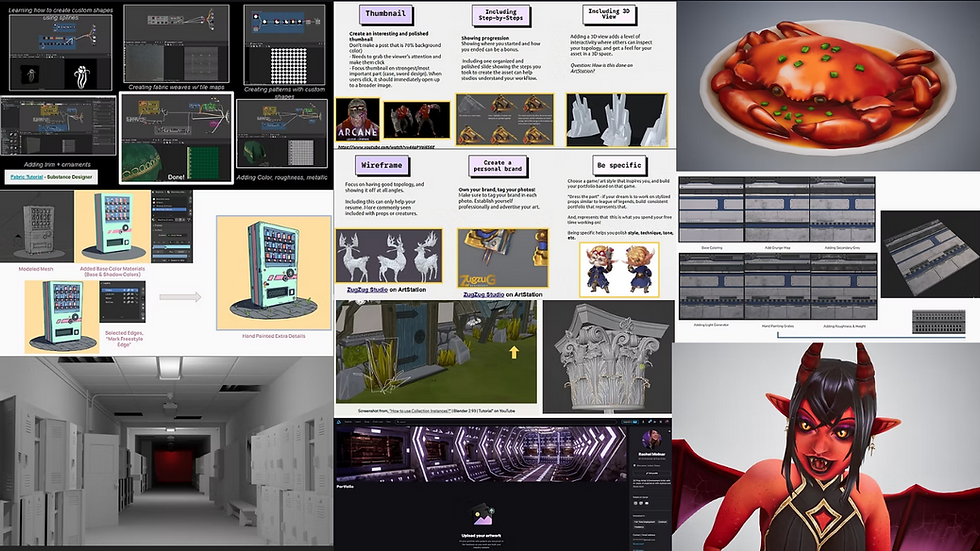
From this video, I also learned what makes a strong ArtStation post and what information should be included with each one—something I’ve been wanting to dive deeper into and better understand.
A quality ArtStation post should include...
An interesting thumbnail: The picture should capture the most interesting part of the piece, and the photo should expand when someone clicks onto it.

Step by steps: Including steps on how you created your piece never hurts, and allows employers to examine your workflow and mindset.

Include 3D View: Include a 3D space for users to navigate your assets and examine your work in detail. This can never hurt and only improve your portfolio.

Include Wireframes: Again, this shows potential employers your understanding of polycount and topology and can only benefit your portfolio. Including wireframe from different angles is a bonus.

Own you art: Establish yourself as an artist - tag your photos in your post, and own your personal brand.

Ultimately, I’ve learned a lot over the past couple of weeks about what makes a great ArtStation portfolio and post. Moving forward, my future milestones will focus on creating high-quality pieces and strong portfolio presentations for my ArtStation, and finally starting to show the world what I’m capable of. I hope you learned something from this post just as I did, and I can’t wait to show you what I create next!


Comments